
SOC Fundamentals: Inside the 24/7 Watchtower of Cybersecurity
TryHackMe Room Walkthroughs · Room 04
When a hacker attacks a company, who is actually watching the screens?
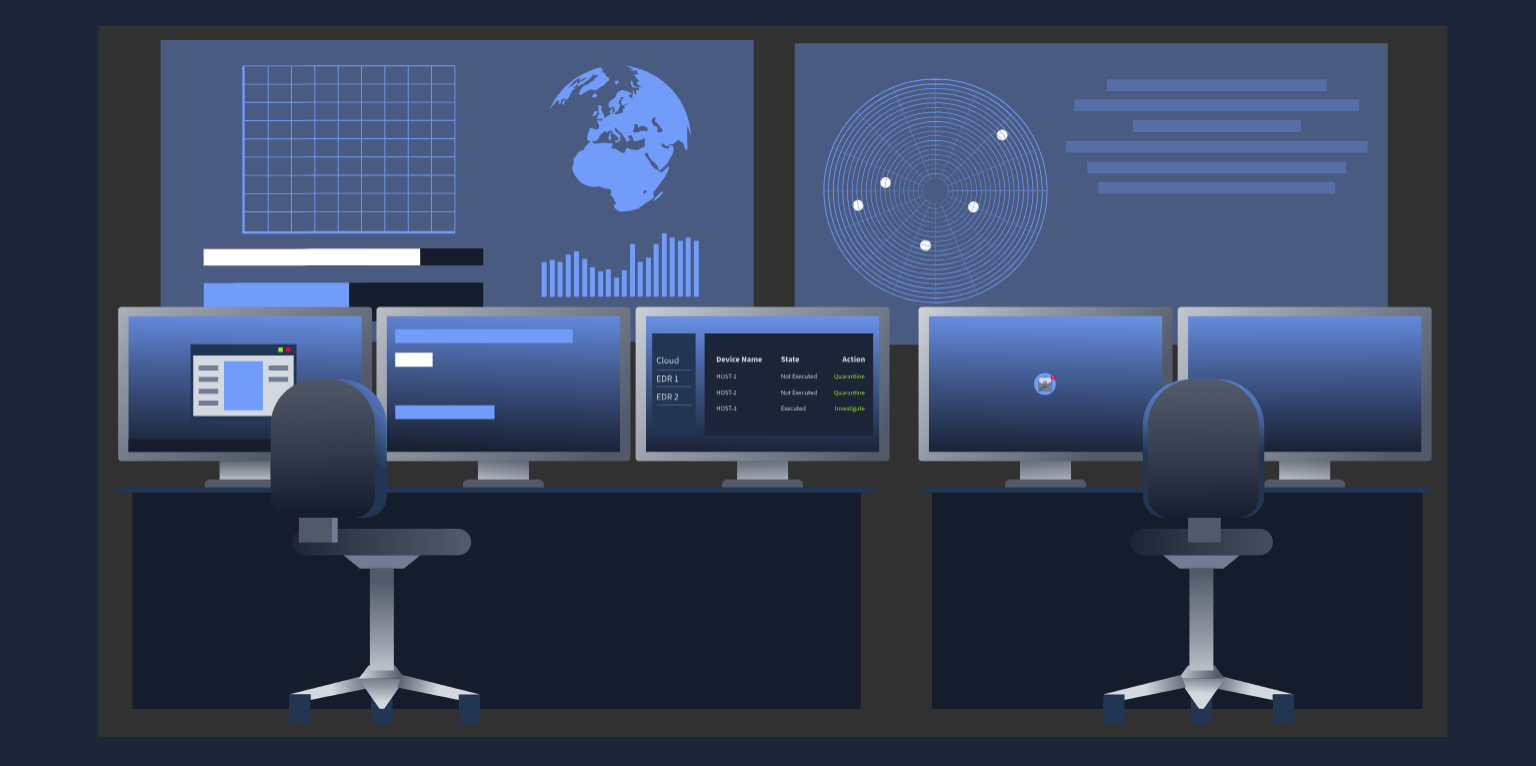
When you think of cybersecurity, you usually picture someone in a dark room typing furiously to stop a hack in real-time. That is the SOC, the Security Operations Center. But it is not just one person, and it is not just a Hollywood movie scene.
I went through TryHackMe’s SOC Fundamentals room to see how the defensive side actually operates. I wanted to know how a company watches its network 24 hours a day, seven days a week, without drowning in alerts.
This is room four of my TryHackMe journey. As always, I’m breaking down the technical jargon into plain English so anyone can understand it.
A quick note: This is a walkthrough of ideas, not answers. I’ve left out flags and quiz answers on purpose so the room keeps its value for you.
📁 Full lab notes and structured report: github.com/Darajat-Mohammed/thm-blue-team-investigations
Lesson 1 & 2: The Watchtower
The core idea: You can't stop what you can't see.
Traditional security (like a simple antivirus) isn't enough anymore. Hackers find new vulnerabilities every day. A SOC is a dedicated facility with a specialized team whose only job is to monitor the organization's network and resources.
Think of it like this. Imagine a castle. You could lock the front door (a firewall) and check everyone's ID (passwords). But what if someone sneaks in through a window? The SOC is the team of guards on the watchtower, using telescopes to look at everything happening inside and outside the castle walls, all day and all night.
The SOC focuses on two things:
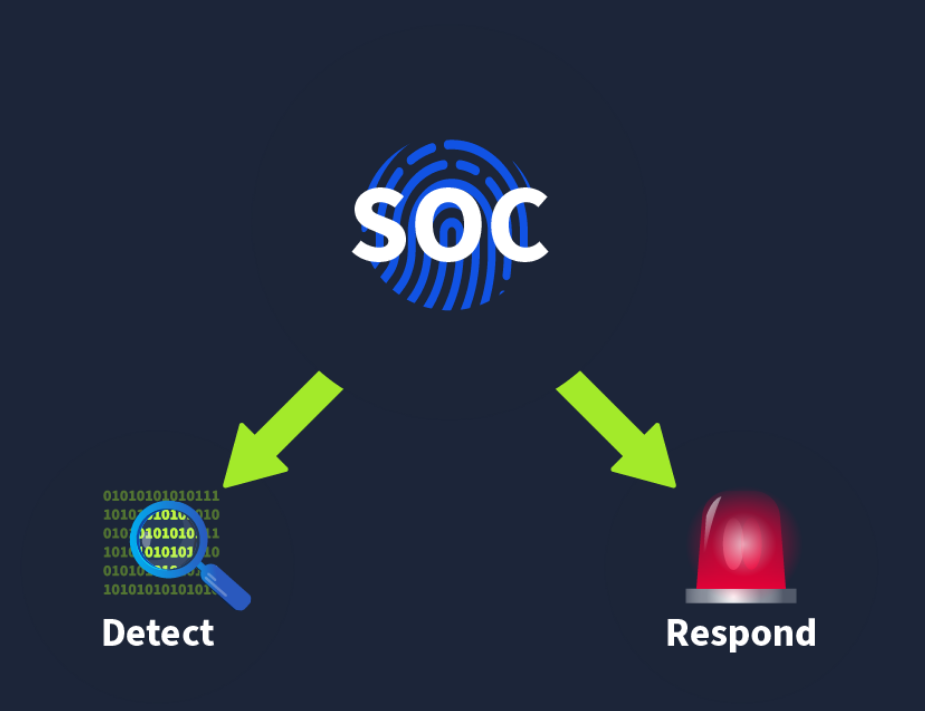
The core loop of the SOC: Find the threat, then stop the threat.
- Detection: Finding vulnerabilities, unauthorized access, policy violations, and active intrusions.
- Response: Minimizing the damage once an attack is detected and figuring out how it happened.
To make this work, a SOC needs three pillars: People, Process, and Technology.
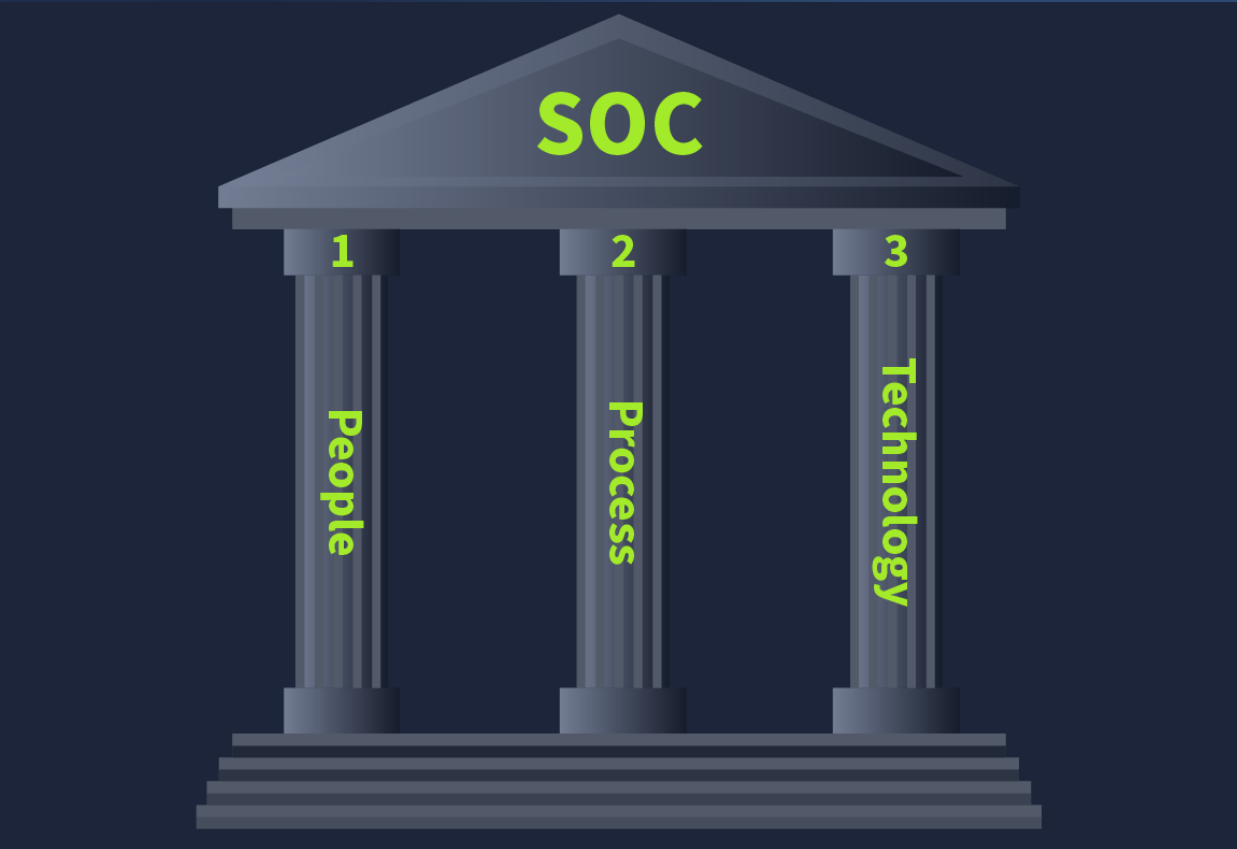
The three pillars that hold up a mature Security Operations Center.
Lesson 3: The Pillar of People (The Human Firewall)
The core idea: Technology is useless without human judgment.
Security tools generate thousands of alerts a day. If you had to investigate every single one, you would burn out. This is why a SOC team is structured like a ladder:
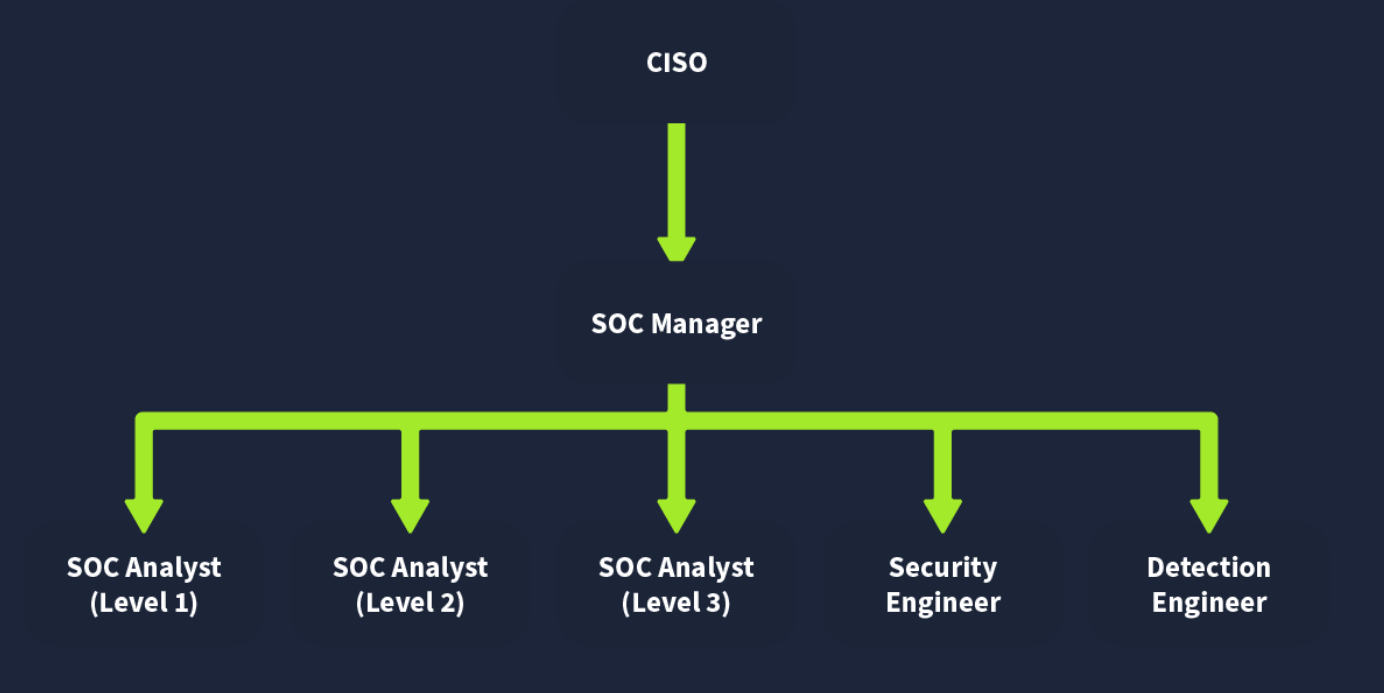
The structure of a SOC team, from the CISO down to the first responders.
- Level 1 (L1) Analyst: The first responders. They look at the alerts and ask, "Is this actually a threat, or is it a false alarm?"
- Level 2 (L2) Analyst: The detectives. If L1 finds a real threat, L2 dives deep into the data to find out exactly what happened.
- Level 3 (L3) Analyst: The elite. They proactively hunt for threats and lead the response when a massive incident occurs.
- Security Engineer & Detection Engineer: The mechanics. They build and tune the tools so the analysts can do their jobs.
- SOC Manager: The captain. They manage the team and report to the CISO (Chief Information Security Officer).
- CISO (Chief Information Security Officer): The executive leader. They oversee the entire security strategy of the company and ensure the board of directors understands the risks
Lesson 4: The Pillar of Process (The 5 Ws)
The core idea: Triage is the foundation of the SOC.
When an alert pops up, you can't just panic. You need a process. The most important process is Alert Triage.
Think of it like this. It is exactly like a doctor in the emergency room. They have to figure out who is bleeding and who just has a sprained ankle so they know who to treat first.
To do this, the SOC analyst answers the 5 Ws:
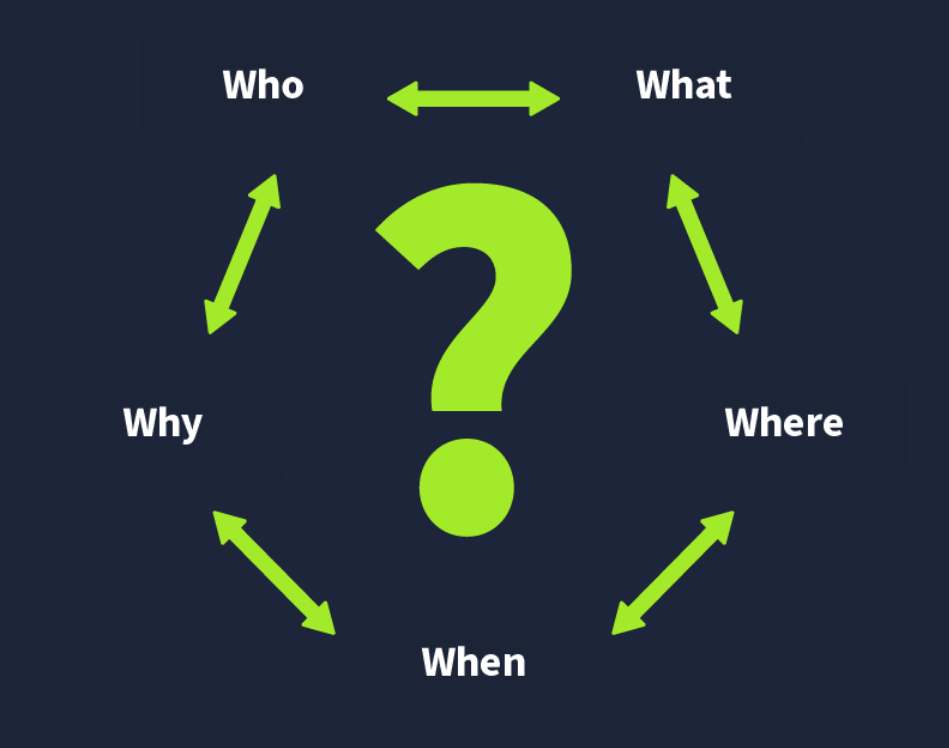
The formula every analyst uses to solve an alert.
- What happened? (e.g., Malware detected)
- When did it happen? (e.g., 1:00 PM)
- Where did it happen? (e.g., On the user George's computer)
- Who is involved? (e.g., User George)
- Why did it happen? (e.g., George downloaded a pirated movie)
Once you have the answers, you report it, escalate it as a ticket to higher-level analysts, and if necessary, start incident response and forensics.
Lesson 5: The Pillar of Technology (The Tools)
The core idea: Security tools centralize the chaos.
A SOC uses a lot of tools, but these are the heavy hitters:
- SIEM (Security Information and Event Management): This is the brain. It collects logs (the diary) from every device on the network, correlates them, and looks for suspicious patterns.
- EDR (Endpoint Detection and Response): This is the bodyguard on the laptop. It watches the actual device and can respond instantly to stop a threat.
- Firewall: The bouncer. It stands between the internal network and the internet, blocking unauthorized traffic.
Lesson 6: The Practical Exercise (Becoming L1)
The core idea: Now it's time to put the theory to the test.
The room dropped me into a simulated environment. I was a Level 1 SOC Analyst, and I got an alert: Port scanning activity was detected.
I opened the SIEM and looked at the raw logs. I had to manually answer the 5 Ws.
I determined who scanned the network, what they were doing, where it happened, when it happened, and why (it turned out to be the vulnerability assessment team running an internal scan).
What I learned. I felt like a real SOC analyst. It wasn't about memorizing commands; it was about taking a massive amount of raw data, filtering out the noise, and telling the story of what actually happened.
Key Takeaways
| Concept | What it means |
|---|---|
| SOC Purpose | Continuous monitoring and response to protect the organization. |
| Detection & Response | The two primary components of SOC operations. |
| The 3 Pillars | People, Process, and Technology must work together. |
| Alert Triage (5 Ws) | Who, What, Where, When, Why. The basis of initial alert analysis. |
| SIEM | Correlates logs from multiple sources to detect threats. |
| EDR | Monitors and responds to endpoint-level activity. |
Final Thoughts
I came into this room thinking a SOC was just a room full of hackers. I came out realizing it is the ultimate team sport.
A SOC is not just about having the most expensive tools. It is about having the right people, following strict processes, and using technology to help them see the threats before the damage is done.
If you are a beginner looking to get into cybersecurity, SOC operations is where the action is. It teaches you how to think under pressure, how to investigate, and how to protect a company from the frontline.
📁 If you want the structured lab report behind this article, with the detailed breakdown of SOC roles, tools, and processes, it's on GitHub: thm-blue-team-investigations
Join the discussion. Are you studying for a SOC role? What is the hardest part of alert triage for you? Comment below, or reach out if you want to collaborate on blue-team writeups, Linux security, or detection content.
Next in the series: another room in my TryHackMe journey, same approach. Understand first, then defend.
Until then, keep exploring, keep experimenting, and keep learning.
Learning platform: TryHackMe
This article is part of my TryHackMe Room Walkthroughs series.
About the author
- I am a Technical Writer and SOC Analyst in training. My mission is simple: I bridge the gap between complex technology and the people who need to understand it. I believe tech shouldn’t be locked behind a wall of jargon. I know what it feels like to be a beginner staring at a terminal, wondering if you need a supercomputer for a brain to make it in this industry. You don't. I write for the career switchers, the self-taught learners, and the everyday users who just want to understand the tools they use. Through my writing, I make the confusing concepts click, so the next person doesn't have to struggle through the same roadblocks I did. I document my own journey into defensive security, but my broader vision is to make all technology accessible to everyone.
Comments
Join the discussionNo comments yet. Be the first to comment.
TryHackMe Room Walkthroughs: Lab Logs & Analysis
Practical TryHackMe room walkthroughs built on clear methodology and hands-on execution. Every post breaks down the exact commands, network behavior, and security concepts behind the challenge serving as a documented proof of work in defensive and offensive operations. https://tryhackme.com/p/DarajatMohammed?utm_campaign=social_share&utm_medium=social&utm_content=profile&cardVersion=ae1bc697010c&utm_source=copy&share_date=2026-11-15&sharerId=6af0da2554c63fd566a6315d